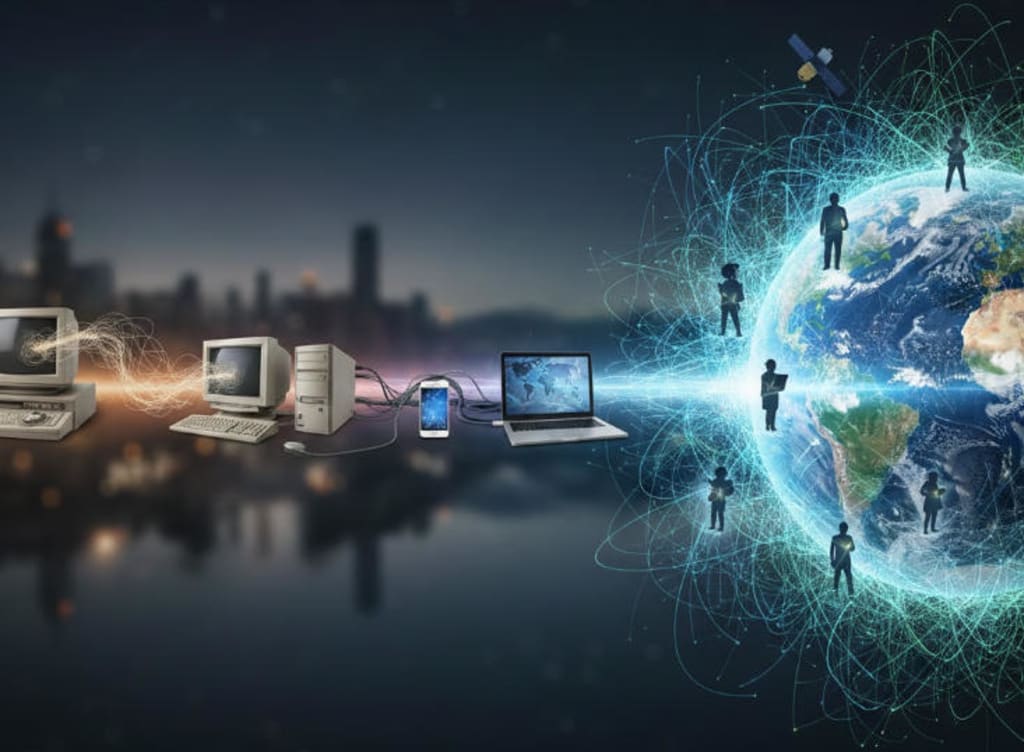
The internet is the defining infrastructure of the modern era. What began as a niche military and academic research project has transformed into a global nervous system, linking billions of people, devices, and economies. It is not a single entity, but rather a vast, decentralized network of networks that operates on standardized communication protocols. Understanding the internet requires looking past the applications used every day and examining the underlying technology, its historical evolution, and its profound socioeconomic impacts.
The Birth of the Network: From ARPANET to Modern Infrastructure
The foundations of the internet were laid in the late 1960s with the creation of the Advanced Research Projects Agency Network, known as ARPANET. Funded by the United States Department of Defense, ARPANET pioneered a technology called packet switching. Before packet switching, communication relied on circuit switching, the technology used by traditional telephone systems, which required a dedicated, continuous physical connection between two points.
Packet switching revolutionized this process by breaking data down into smaller, manageable chunks called packets. Each packet contains a portion of the payload data along with a header that specifies its source and destination. These packets travel independently across a network, often taking completely different physical routes depending on traffic and network health, and are reassembled in the correct order once they reach the destination.
In the 1970s, scientists Vinton Cerf and Robert Kahn developed the Transmission Control Protocol and the Internet Protocol, collectively known as TCP/IP. This suite of rules became the standard language of the network, allowing entirely different computer systems to communicate seamlessly. By 1983, ARPANET adopted TCP/IP, marking the official birth of the internet.
The network remained largely text-based and confined to academic, governmental, and military circles until 1989, when British scientist Tim Berners-Lee invented the World Wide Web. While people often use the terms internet and web interchangeably, they are distinct. The internet is the physical and technical infrastructure of connected computers. The World Wide Web is an information management system that operates on top of the internet, utilizing hyperlinks and Uniform Resource Locators to make documents and media easily accessible via a web browser.
How Data Moves Across the Globe
The physical reality of the internet is far more tangible than terms like the cloud suggest. Data does not mostly travel through the air; it moves through a massive physical infrastructure of cables, switches, routers, and data centers.
The Backbone and Subsea Cables
The core of the internet consists of high-speed fiber-optic communication lines called the internet backbone. These lines are capable of transmitting immense amounts of data over long distances. To connect continents, private consortiums and telecom companies have laid hundreds of thousands of miles of submarine fiber-optic cables along the ocean floor. These cables, wrapped in heavy protective layers to withstand deep-sea pressure and marine life, carry over 95 percent of all transcontinental data traffic.
Routing and the Domain Name System
When a user requests a website, the request is broken into packets and sent to a local router. Routers act as traffic controllers, examining the destination address of each packet and determining the most efficient path forward.
Computers identify each other using numerical addresses called IP addresses, such as 192.0.2.1. Because these numbers are difficult for humans to remember, the Domain Name System was created. The Domain Name System acts as the phonebook of the internet. When a user types a human-readable domain name into a browser, a Domain Name System server translates that name into the corresponding numerical IP address, allowing the browser to locate the correct server.
The Socioeconomic Impact of Total Connectivity
The widespread adoption of the internet has fundamentally restructured how human beings learn, work, communicate, and conduct commerce.
The Democratization of Information
Historically, access to knowledge was guarded by physical and financial barriers, concentrated in libraries, universities, and elite institutions. The internet dismantled these barriers by making information universally accessible. Educational platforms, open-access research databases, and collaborative encyclopedias allow anyone with an internet connection to learn advanced topics, acquire vocational skills, or access historical archives for free or at a minimal cost.
Economic Transformation and E-Commerce
The internet has birthed entirely new industries while forcing legacy businesses to adapt or face extinction. E-commerce has shifted retail from physical storefronts to global marketplaces, optimizing supply chains and lowering overhead costs for entrepreneurs.
Furthermore, the internet has redefined the workplace. High-speed broadband, cloud computing, and collaborative software suites enabled the rise of remote and hybrid work models. Companies can now source talent globally, while workers gain geographic flexibility, altering corporate structures and commercial real estate markets.
Social Dynamics and Digital Communities
Human interaction is no longer constrained by geographic proximity. The internet allows individuals with niche interests, shared identities, or rare conditions to find one another and form robust digital communities. Social media platforms have accelerated the speed of cultural exchange, political movements, and news dissemination, giving a global voice to marginalized groups and enabling real-time mobilization.
Systemic Challenges and the Future Landscape
Despite its benefits, the rapid expansion of the internet has introduced complex technical, social, and geopolitical vulnerabilities that society must address.
Cyber Security and Data Privacy
As critical infrastructure, banking systems, and personal identities migrate online, the incentive for malicious cyber activity grows. Cyber security is now a primary national security concern for governments and a major operational risk for corporations. Threat actors utilize malware, ransomware, and phishing attacks to breach networks, steal proprietary data, and disrupt essential services.
Simultaneously, the business model of the modern web heavily relies on surveillance capitalism, where user data is harvested, analyzed, and monetized for targeted advertising. This has sparked intense debates and regulatory responses regarding digital privacy rights, consent, and data ownership.
The Digital Divide
While much of the world takes high-speed connectivity for granted, a stark digital divide persists. Rural areas, developing nations, and low-income communities often lack the physical infrastructure or economic resources required for reliable internet access. This divide exacerbates socioeconomic inequality, as those without connectivity are cut off from modern education, job markets, and digital government services.
The Splinternet and Geopolitical Control
The original vision of the internet was an open, borderless commons. However, authoritarian regimes have increasingly implemented sophisticated filtering and censorship systems to control the flow of information within their borders. This phenomenon, often referred to as the splinternet, threatens to fracture the global network into isolated national intranets controlled by local political agendas.
Frequently Asked Questions
What is the difference between IPv4 and IPv6?
IPv4 is the fourth version of the Internet Protocol, which uses a 32-bit addressing scheme, allowing for approximately 4.3 billion unique IP addresses. Due to the massive explosion of connected devices, these addresses have been depleted. IPv6 was developed as the successor, utilizing a 128-bit addressing scheme that allows for an astronomically large number of unique addresses, ensuring the internet can continue to expand indefinitely.
How do fiber-optic cables transmit data faster than copper wires?
Copper wires transmit data using electrical impulses, which degrade over long distances and are susceptible to electromagnetic interference. Fiber-optic cables use thin strands of glass or plastic to transmit data as pulses of light. Because light travels incredibly fast and suffers minimal signal loss over long distances, fiber optics provide vastly superior bandwidth and speed compared to copper.
What is the dark web and how does it differ from the deep web?
The deep web refers to any part of the internet that is not indexed by conventional search engines. This includes secure pages like online banking portals, private databases, and email inboxes. The dark web is a small, intentional subset of the deep web that requires specific, anonymizing software like Tor to access. While it is used for privacy and by whistleblowers, it also hosts illicit marketplaces due to its hidden nature.
What does net neutrality mean?
Net neutrality is the principle that internet service providers must treat all data on the internet equally. Under net neutrality rules, providers are prohibited from intentionally blocking, slowing down, or charging extra for specific websites, applications, or content types, ensuring a level playing field for all online services.
How does satellite internet work compared to traditional broadband?
Traditional broadband relies on physical cables running directly to a home or business. Satellite internet bypasses ground infrastructure by transmitting data wirelessly between a user’s satellite dish and a constellation of satellites orbiting the Earth, which then communicate with ground stations connected to the internet backbone. This is particularly useful for providing connectivity to remote or underserved regions.
What is the Internet of Things?
The Internet of Things refers to the network of physical objects embedded with sensors, software, and network connectivity that allows them to collect and exchange data. Common examples include smart thermostats, wearable fitness trackers, and industrial machinery, all of which communicate over the internet to automate tasks and provide real-time insights.
